
 View all
 Champagne
 Sparkling Wines
 Red Wines
 White Wines
 Rosé Wines
 Alcohol-free
 Bag in box
 Fortified Wines
 Passito Wines
 Cocktails
 Gin
 Liqueur
 Rum
 Whisky
 Grappa
 Alcohol-free
 Brandy
 Eau de vie
 Tequila
 Vodka
 Mixology
 Beers
 Olive Oil
 Vinegar
 Accessories
Château Lagrange
Château Lagrange is a Troisième Grand Cru Classé of 1855 from the Saint-Julien appellation in the Médoc, on the left bank of the Gironde between Margaux and Pauillac. Its origins go back to the Middle Ages, when the term “grange” referred to a vast estate with dwellings, a church, and farm buildings. In the eighteenth century the de Branne family developed the vineyard, and in 1787 Thomas Jefferson, the United States ambassador to France, ranked Lagrange third in his personal classification.
In 1842 Count Duchâtel, Minister of the Interior under Luigi Filippo, purchased the estate and introduced land drainage; in 1845 the Tuscan tower was built to a design by the architect Visconti. In 1983 Keizo Saji, son of the founder of Suntory, took over the property, initiating a profound renaissance and, from the mid-1990s, a policy of sustainable development.
The vineyard forms a single block around the château, with the same parcels classified in 1855, on two ridges of Gunzian gravels, one of which is the highest point of the Saint-Julien appellation. The estate is completed by around forty hectares of parkland and woodland, and a lake.
History, continuity of the terroir and care for the environment make Château Lagrange one of the most elegant expressions of Saint-Julien.

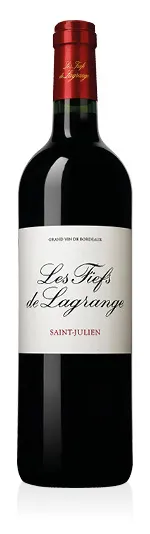
Saint-Julien AOC 2ème Vin Les Fiefs de Lagrange 2023 Château Lagrange


